Case Study · Supplements · Vitamin Gummies · Launch-Stage
HAroutine

From $6K to $100K/month in 14 months — built on subscriptions, not short-term ACOS.

A launch-phase health and vitamin gummies brand running ad spend that exceeded its revenue. We bet against the conventional ACOS playbook and built a new-to-brand acquisition engine around Subscribe & Save — turning every customer into a compounding revenue stream.

15×
Monthly Revenue Growth
5.9×
Subscriber Growth
$684K
14-Month Revenue
14 mo
Engagement Window

The brand

HAroutine sells health and vitamin gummies — a fast-growing niche inside the supplements category, anchored by a strong product line including their flagship advanced collagen gummies. When we took over the account, the brand was barely generating meaningful revenue. Ad spend was consistently exceeding total sales.

That sounds like a problem. In supplements at the launch stage, it's usually a feature — if you've got the right strategy. The real play in this category isn't immediate profit. It's acquiring new-to-brand customers who will subscribe and reorder over time, compounding lifetime value into a profitable engine that nobody can dislodge.

The goal from day one was clear: build a growing base of loyal subscribers, drive Subscribe & Save count, and scale the account to a point where the unit economics make sense at volume.

The challenge

The product was strong, the category was right, the margins were viable at scale — but the structure to capture them wasn't there. The brand was running paid traffic without a system to convert those clicks into long-term customers.

  • Ad spend consistently outpacing revenue — common in supplements but with no documented path to profitability
  • No structured new-to-brand acquisition strategy — every dollar treated like a one-shot transaction
  • Subscription numbers flat at ~160 active subscribers, limiting predictable revenue
  • Strong product quality but low marketplace visibility and weak organic ranking
  • Listings not optimized for the high-intent keywords that convert in the gummies space
~160 subs
The starting point in February 2025. By March 2026, that number had crossed 940 — a 5.9× compounding base.

Our approach

In supplements, the team that wins is the team that builds the subscription base before chasing profitability. We restructured the account around acquisition first, then scaled what was working.

  1. New-to-Brand Customer Acquisition First

    Rather than chase short-term ACOS efficiency — the trap most launch-stage brands fall into — we built campaigns specifically designed to pull in first-time buyers. Sponsored Brands video ads for top-of-funnel discovery, competitor ASIN targeting on the listings of brands with the right shopper intent, and category placements to get in front of audiences already buying similar products.

    The metric we optimized for wasn't ACOS. It was new-to-brand units — every new customer was the start of a subscription LTV calculation, not a one-shot transaction.

  2. Organic Rank & Listing Optimization

    We ran a full listing audit — titles, bullets, backend keywords, A+ content — and rebuilt the SEO foundation from scratch. Better listings convert better. Better listings rank better. Better listings make every ad dollar work harder. The fundamentals weren't optional; they were the multiplier underneath everything else.

    By the time we layered paid traffic on top of the rebuilt listings, both the conversion rate and the organic discoverability were doing meaningful work. Lower wasted spend, higher returns per click.

  3. Subscribe & Save Growth Engine

    Supplements live and die by subscriptions. A $30 one-time purchase is fine. A $30/month autoship for the next two years is the entire business. We structured keyword targeting and bidding to prioritize high-intent shoppers most likely to subscribe — branded search, "best [ingredient] for [outcome]" terms, and competitor brand defense.

    This meant slightly higher upfront ad cost per acquisition, but dramatically better LTV per customer. The payback math worked because we were buying subscribers, not transactions.

  4. Progressive Budget Scaling Based on Performance

    As performance data came in, we reinvested ad spend where conversion signals were strongest. Rather than locking in flat monthly budgets, we scaled spend in line with what the data was telling us — pulling back on weaker placements and doubling down on what worked.

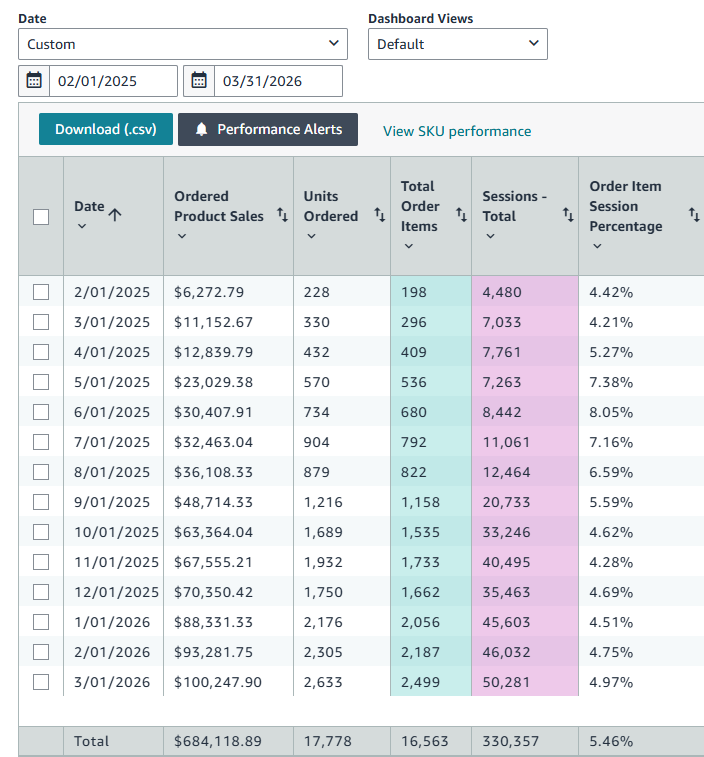
    Revenue climbed from $6K in February 2025 to over $100K in March 2026. The growth wasn't linear — it was compounding, because each month added another wave of subscribers feeding into the next month's revenue base.

The Results

14 months in: 15× MRR, 6× subscribers, $684K total — and a base that compounds.

Starting from $6K/month in Feb 2025, the brand crossed $100K/month by March 2026. Subscription count went from ~160 to nearly 940 — while the prior year's subscriptions stayed flat at ~200. That gap is the entire compounding effect of getting acquisition right.

$6K → $100K
Monthly Revenue — 15× growth across 14 months
160 → 940
Active Subscribers — 5.9× compounding base, prior year stayed flat at ~200
$684K
Total Revenue — 17.7K units across 16.5K orders, 5.46% session conversion
Subscription LTV engine built — every new customer feeds future revenue automatically
Listing SEO rebuilt to rank organically on hero gummies keywords
Path to profitability mapped — no longer betting on every-month ACOS
Account structured to scale from $100K/mo into the seven-figure annual band
"

In supplements, the team that wins is the team that builds the subscription base before chasing profitability. Every subscriber is a compounding asset — the unit economics get better with every month they stay.

— The HAroutine Engagement

Launching or scaling a supplement brand on Amazon? We've done this before.

Free 30-min strategy call. We'll pull up your account live, audit your subscription strategy, and show you the three biggest acquisition levers we'd pull. Whether we work together or not.

Book a Free Strategy Call

More case studies

Different stages of the curve. Same approach: structure, prioritization, senior attention.